
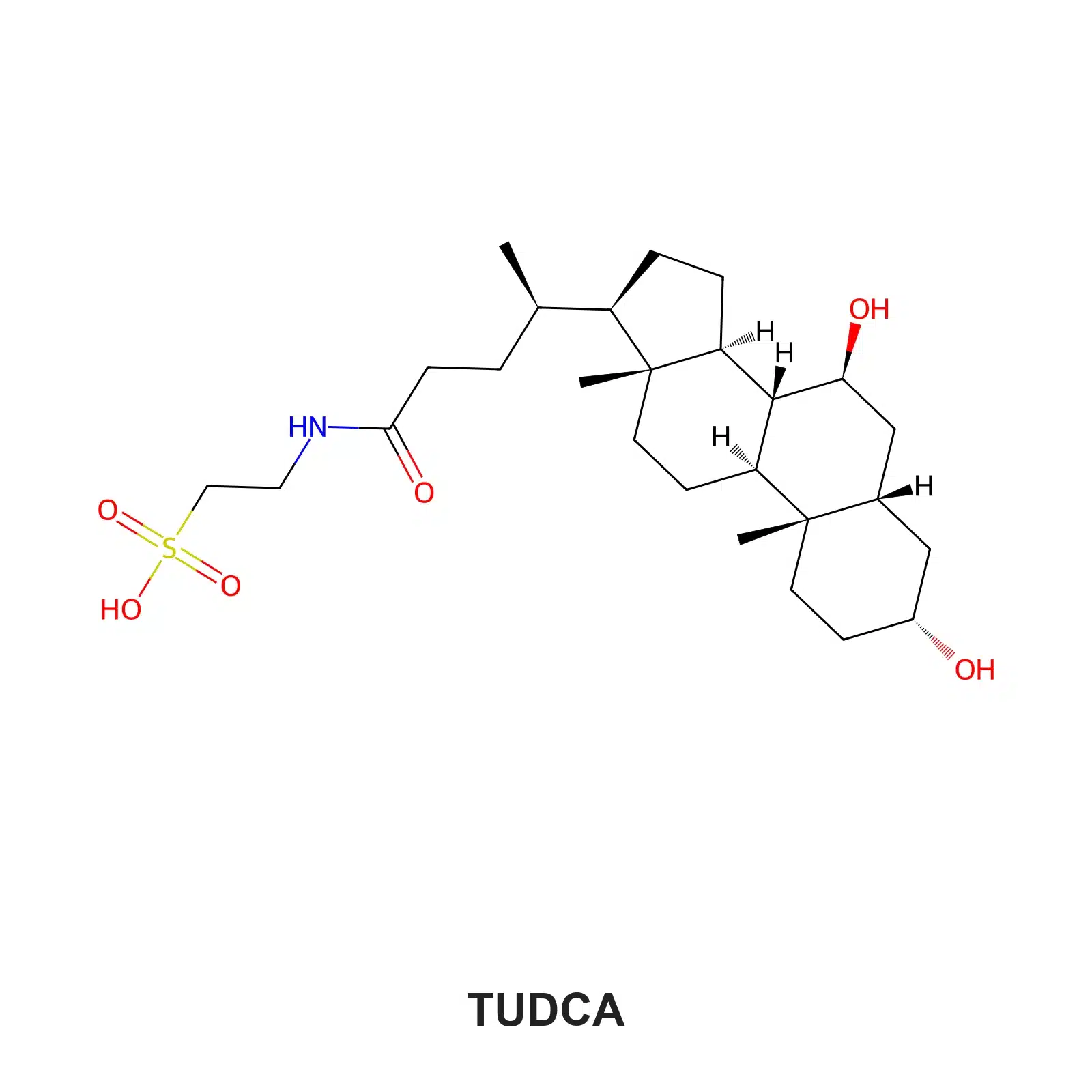
TUDCA (Tauroursodeoxycholic Acid)
Preisspanne: 27,00 € bis 50,00 €
Note: For research and educational purposes only. Not intended for human consumption
TUDCA · TAUROURSODEOXYCHOLIC ACID
A closer look at liver support and cellular resilience.
The liver works quietly in the background, processing nutrients and producing bile. Inside its cells, an equally busy world keeps proteins working and energy production running. TUDCA brings these two perspectives together: a bile acid with an intriguing profile in liver research and the study of how cells cope with stress.
Short for tauroursodeoxycholic acid, TUDCA combines ursodeoxycholic acid with taurine. Its appeal reaches from human findings on liver blood tests and insulin sensitivity to laboratory work on protecting vulnerable cells. The connecting idea is simple: helping essential processes keep working when conditions become demanding.
What makes TUDCA worth a closer look?
Cellular stress is different from feeling mentally stressed. It describes a situation in which a cell struggles with its workload or faces damage. Proteins can lose their working shape, energy-producing structures can become disrupted, and protective responses can become overwhelmed. TUDCA is studied for its potential to influence these processes, alongside its established identity as a bile acid.
- A liver-centred starting point: Human studies have examined TUDCA in a specific condition affecting the liver’s small bile ducts.
- An interest in protection from within: Laboratory findings explore how it may help preserve cell function during chemical stress.
- A metabolic connection: A small controlled human study investigated how liver and muscle respond to insulin.
i) The Pharmacology of TUDCA
1. Liver and bile function: the foundation of its appeal
Bile helps the body handle dietary fats and carries certain waste products out through the digestive system. TUDCA belongs to this family of molecules, giving it a direct connection to the environment in which liver cells work.
In a 24-week trial involving 199 people with primary biliary cholangitis, TUDCA and the related compound UDCA produced similar improvements in several liver blood tests. This provides a concrete human finding behind the interest in liver support, while remaining specific to that condition and the medical preparations studied. It does not establish a general “detox” effect.
2. Giving a cell’s protein workshop more breathing room
Proteins need the right shape to do their jobs. A structure inside the cell helps prepare them, rather like a workshop checking that each part is ready to work. When that system becomes overloaded, the resulting strain is called endoplasmic reticulum stress.
TUDCA is often described as a chemical chaperone because of its role in experiments investigating this strain. In cultured liver cells exposed to a toxic chemical, it reduced stress signals and cell damage. The attractive possibility is preserving the cell’s ability to function under pressure, rather than simply describing it as an “antioxidant”. This protective effect was observed in the laboratory.
Why this matters: A cell needs working proteins as well as energy. TUDCA’s research profile connects these two essential parts of cellular maintenance.
3. Protecting the structures that keep cells running
Mitochondria help supply a cell’s energy. When their membranes become damaged, they can also release signals that contribute to cell death. In chemically stressed rat nerve cells, TUDCA helped preserve aspects of these membranes and reduced cell death.
This is the basis for interest in cellular resilience: keeping essential structures intact when they are challenged. It is a laboratory finding, not a demonstrated boost in everyday energy or cognition. The later large ALS trial did not confirm a clinical benefit, so those early protective findings should not be read as evidence of an effective neurological treatment.
4. A more responsive metabolic system
Insulin is a signal that helps coordinate how the body handles glucose. When tissues become less responsive, that signal has less effect. In a four-week placebo-controlled study of 20 adults with obesity, TUDCA improved measured insulin sensitivity in liver and muscle by approximately 30%.
The appeal is a more responsive relationship between a metabolic signal and the tissues receiving it. This was a small, short study of a measured biological response; it did not establish weight loss or diabetes prevention. Importantly, the measured muscle and fat-tissue stress markers did not improve, so the human result cannot simply be attributed to the laboratory mechanism above.
Summary of Pharmacological Activity
| Area | What the findings show | Potential appeal |
|---|---|---|
| Liver function | Improved liver blood tests in a human bile-duct disease trial. | A focused interest in liver and biliary support. |
| Cellular workload | Less stress and damage in chemically challenged liver cells. | Helping cells cope when their internal systems are under strain. |
| Cell protection | Preserved mitochondrial features and reduced cell death in a nerve-cell experiment. | Protection of structures essential to cell survival. |
| Metabolic response | Greater liver and muscle insulin sensitivity in a small human trial. | Exploring a more responsive glucose-handling system. |
ii) Potential / Hypothetical Profile
- Liver & Biliary Support: TUDCA’s distinctive starting point, supported by condition-specific human findings and its relationship to bile-acid biology.
- Cellular Resilience: The possibility of helping cells withstand internal strain, with experimental interest in both protein processing and mitochondrial protection.
- Metabolic Support: Early human findings make insulin responsiveness an interesting area to explore, without turning a biological measurement into a promise of a visible result.
Explore the research: Liver trial · Liver-cell stress · Mitochondrial protection in cells · Human insulin-sensitivity study · TUDCA-ALS trial update.
| Συσκευασία | 15 g, 30 g |
|---|
TECHNICAL SPECIFICATIONS
- Product Name: Tauroursodeoxycholic Acid (TUDCA)
- CAS Number: 14605-22-2
- Molecular Formula: C26H45NO6S
- Molecular Weight: 499.70 g/mol
DISCLAIMER
As stated in the short description, this and other products of subsection of “Nootropics” in our e-shop are NOT intended for human consumption! Those products are available for collection purposes or for other lawful use for which the consumer has taken care to be explicitly informed on a personal level in every aspect that may be affecting them.
The information provided in the descriptions of products which can be found in “Nootropics” subsection – as available from ethosherbals.com, SMARTSHOP Main Category – is of an academic nature. This information is not intended to be used for human consumption of the products in question. It is not intended to diagnose, prevent or treat any medical condition. It is not intended to be a substitute for any medical treatment.
Du musst angemeldet sein, um eine Bewertung abgeben zu können.


 Ethos Herbals Blends
 Κάνναβη
 SmartShop
 VapeShop
 Θεραπευτικά Βότανα
 Κακάο & Τσάι
 Αρωματοθεραπεία
 Ethos Lifestyle
Bewertungen
Es gibt noch keine Bewertungen.