
Epithalon (Epitalon)
27,00 €
Note: For research and educational purposes only. Not intended for human consumption.
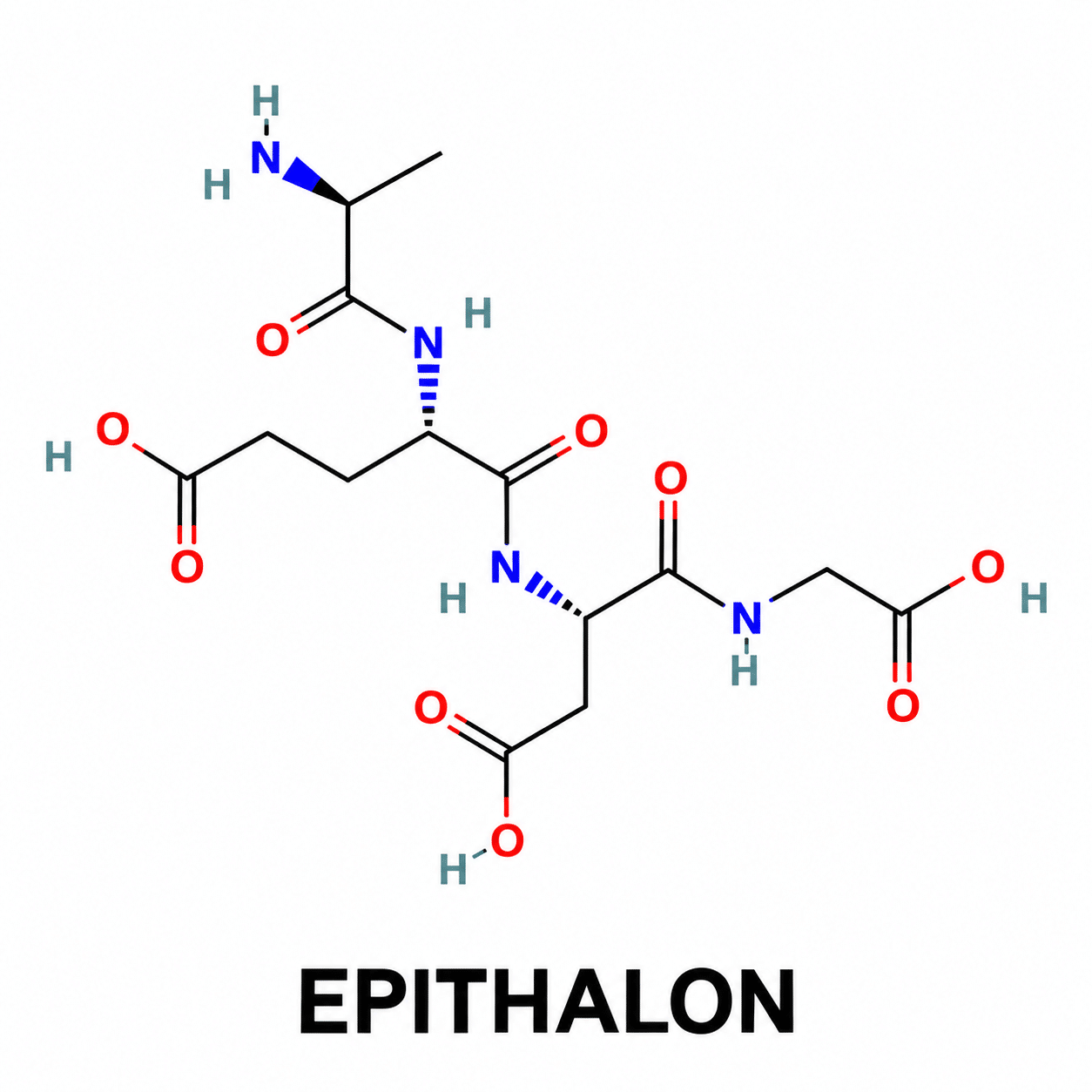
Epithalon, also known as Epitalon, brings together two compelling areas of longevity research: how cells maintain themselves and how the body keeps its daily rhythm. This four-amino-acid peptide — Ala-Glu-Asp-Gly — has attracted attention for its effects on telomere biology, melatonin-related signals and cellular responses to stress.
Its appeal lies in these underlying processes: preserving the protective ends of chromosomes, exploring the signals behind the body’s internal clock, and understanding how cells respond to the pressures associated with ageing.
i) 🧬 Primary Pharmacological Actions of Epithalon
🔹 1. Telomeres & Cellular Maintenance
Telomeres are protective stretches of DNA at the ends of chromosomes. They help safeguard genetic material and can shorten as cells divide. Telomerase is one of the enzymes that helps maintain them.
- Early experiments in human fibroblast cultures found that Epithalon increased telomerase activity and lengthened telomeres.
- A follow-up study reported that treated cells continued dividing beyond the point at which untreated cells stopped.
- A 2025 study extended this work to additional human cell lines, finding that the route to telomere extension depended on the cell type.
The appeal: exploring whether cellular maintenance can be preserved for longer — a central question in healthy-ageing research.
🔹 2. Melatonin & the Body’s Internal Clock
Good timing matters. Melatonin helps signal the biological night, while clock genes help coordinate daily patterns across the body. Epithalon’s connection with these signals gives it a distinctive place in research on circadian balance.
- In older rhesus monkeys, Epithalon increased evening melatonin and shifted cortisol secretion toward a clearer daily rhythm.
- A small human study involving night-shift workers reported changes in a urinary marker of melatonin production and in the activity of circadian genes.
The appeal: the possibility of supporting the signals that keep biological rhythms in step. The human findings concern these signals; sleep quality itself was not measured.
🔹 3. Cellular Defences Against Stress
Cells have their own protective machinery for dealing with oxidative stress — chemical stress that can damage cellular components when it overwhelms their defences.
- In a study of human skin fibroblasts exposed to ultraviolet radiation, AEDG increased the expression of several genes involved in antioxidant defence.
- This points to an interest in how cells activate their protective responses under stress.
The appeal: investigating cellular resilience and the maintenance of normal function under challenging conditions.
🧬 Summary of Pharmacological Activity
| Area | What the findings show | Potential appeal |
|---|---|---|
| Telomere maintenance | Human cell-culture studies report longer telomeres and changes in telomerase activity. | Understanding how cells maintain their capacity to divide. |
| Biological rhythms | Primate work and a small human study report changes in melatonin-related and clock signals. | Exploring a more coordinated internal rhythm. |
| Cellular stress responses | UV-exposed human skin-cell cultures showed increased expression of antioxidant-defence genes. | Investigating how cells preserve function under stress. |
ii) Potential / Hypothetical Profile
- Healthy-Ageing Potential: interest in the cellular maintenance processes that underpin how cells change over time.
- Circadian Balance: a focus on the body’s own timing signals and their relationship with the daily cycle of activity and rest.
- Cellular Resilience: the possibility of strengthening protective responses to oxidative stress, as explored in cell experiments.
Selected References
- Telomerase and telomere findings in human cell cultures (2003); cell-division follow-up (2004).
- Telomere mechanisms across human cell lines (2025), with published figure correction.
- Melatonin and cortisol findings in older monkeys (2001).
- Human melatonin-related markers and circadian genes (2021).
- Antioxidant-defence gene expression in skin-cell cultures (2022).
| Συσκευασία | 10 mg. |
|---|
TECHNICAL SPECIFICATIONS
- Product Name: Epithalon (Epitalon)
- CAS Number: 307297-39-8
- Molecular Formula: C14H22N4O9
- Molecular Weight: 390.35 g/mol
- Purity : >99%
- Test Method : COA/Lcms/Nmr/HPLC/UV
DISCLAIMER
As stated in the short description, this and other products of subsection of “Nootropics” in our e-shop are NOT intended for human consumption! Those products are available for collection purposes or for other lawful use for which the consumer has taken care to be explicitly informed on a personal level in every aspect that may be affecting them.
The information provided in the descriptions of products which can be found in “Nootropics” subsection – as available from ethosherbals.com, SMARTSHOP Main Category – is of an academic nature. This information is not intended to be used for human consumption of the products in question. It is not intended to diagnose, prevent or treat any medical condition. It is not intended to be a substitute for any medical treatment.
Vous devez être connecté pour publier un avis.
Vous aimerez peut-être aussi…
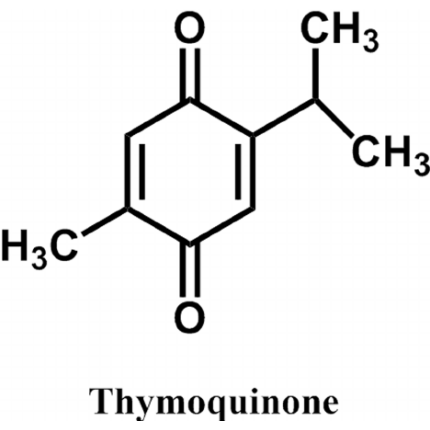
Black Seed Oil – Έλαιο Μαύρου Κύμινου Ψυχρής Έκθλιψης (~4,5 % Volatile Oils) 100ml
11,00 €
Holy Basil (Tulsi)
Plage de prix : 4,40 € à 7,80 €
Ethos Herbals Μελισσόχορτο Βάμμα
Plage de prix : 7,60 € à 13,20 €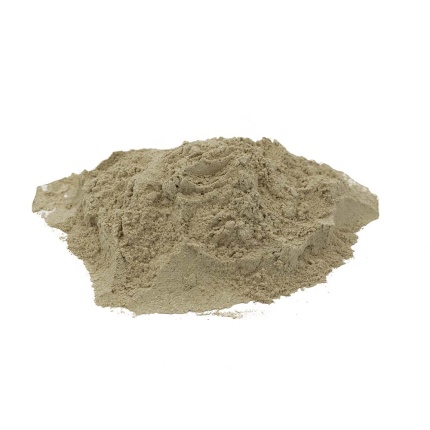
Ashwagandha
Plage de prix : 3,40 € à 5,20 €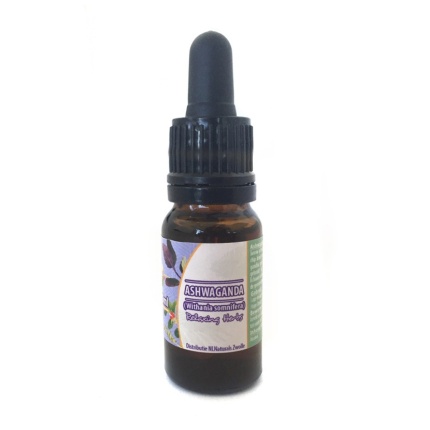
Ashwagandha Βάμμα 10ml
22,60 €
Ethos Herbals CBN Isolate 99,6%
Plage de prix : 13,30 € à 21,40 €


 Ethos Herbals Blends
 Κάνναβη
 SmartShop
 VapeShop
 Θεραπευτικά Βότανα
 Κακάο & Τσάι
 Αρωματοθεραπεία
 Ethos Lifestyle
Avis
Il n’y a pas encore d’avis.