
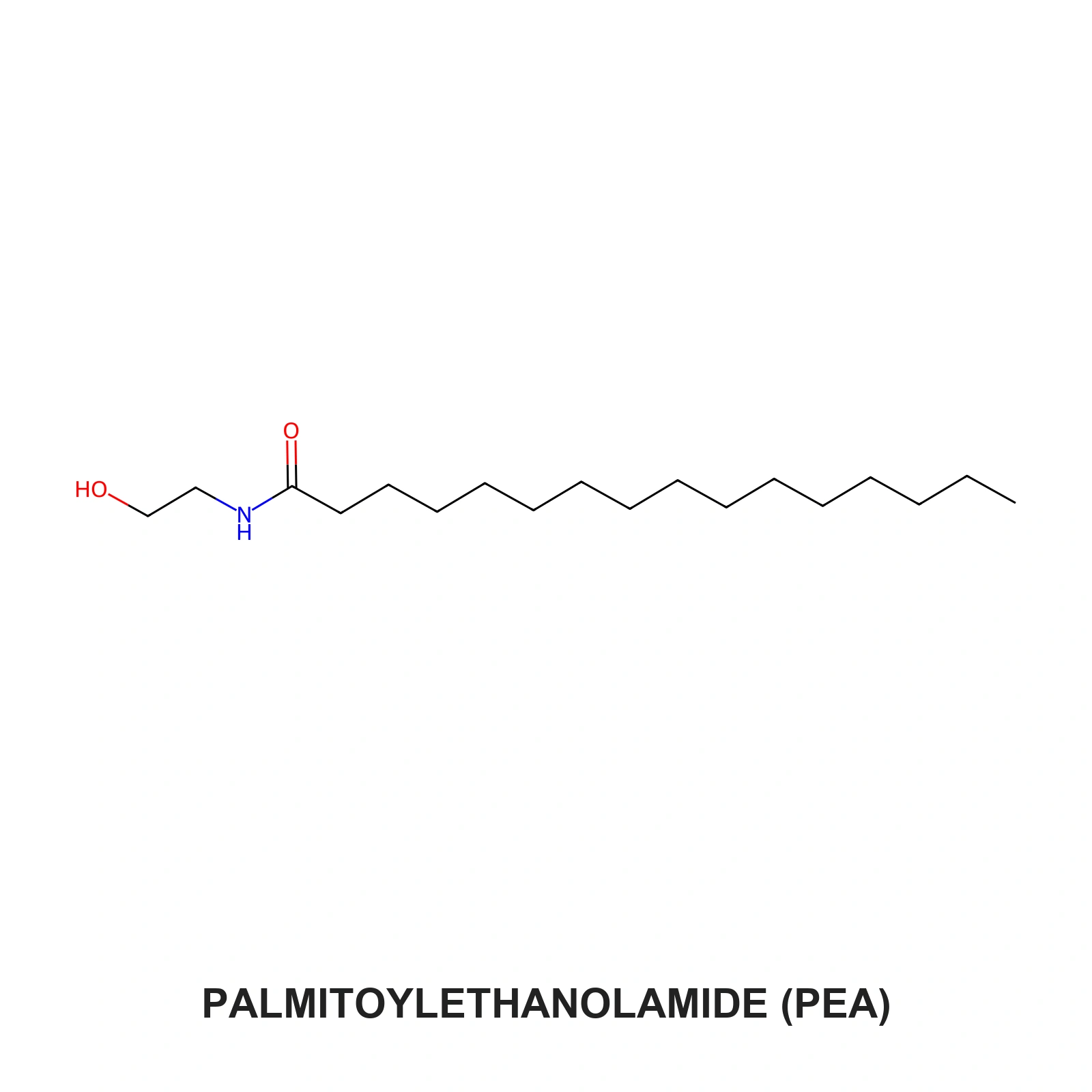

Palmitoylethanolamide (PEA)
Plage de prix : 19,00 € à 29,00 €
Note: For research and educational purposes only. Not intended for human consumption
PALMITOYLETHANOLAMIDE · PEA
Physical comfort. Easier movement. More room for rest.
Persistent discomfort has a way of taking up space: in a morning walk, an ordinary working day, or the moment you finally settle down for the night. Palmitoylethanolamide (PEA) has attracted interest for its potential to make that discomfort less intrusive, with human studies exploring joint pain, nerve-related discomfort and the effect of pain on everyday life.
A fatty-acid compound also produced naturally in the body, PEA is part of the conversation between cells. Its role in regulating inflammatory signals gives it a distinctive appeal: exploring comfort through processes the body already uses to keep its responses in balance.
What makes PEA worth a closer look?
PEA connects an interesting biological mechanism with outcomes people can understand. Less stiffness, fewer interruptions from discomfort and more settled rest are meaningful possibilities because they relate to the texture of an ordinary day. Its research profile includes controlled human studies, alongside laboratory work investigating how those effects might arise.
- A naturally occurring messenger: PEA belongs to a family of fat-based compounds involved in communication between cells.
- A focus on physical comfort: Much of its clinical research concerns pain, stiffness and how easily people can carry out everyday activities.
- A connection between comfort and rest: Some findings extend beyond pain scores to sleep and the disruption discomfort causes.
i) The Pharmacology of Palmitoylethanolamide (PEA)
1. Helping turn down persistent inflammatory signals
Inflammation is one way the body responds to damage or irritation. When that response stays active, it can contribute to ongoing tenderness and discomfort. PEA’s best-established experimental target is PPAR-alpha — a control switch inside cells that helps regulate inflammatory activity.
Laboratory and animal studies show that PEA can activate this switch. In plain English, researchers are looking at how it may help turn down some of the signals that keep an inflammatory response going. That is the biological foundation behind much of the interest in its potential for physical comfort.
Why this matters: Pain research looks at both the sensation itself and the processes that can keep it active. PEA’s influence on inflammatory signalling makes that second part especially interesting.
2. Joint comfort that could make movement feel easier
Stiffness can make familiar movements feel like more of an effort. The appeal of greater joint comfort lies in practical things: walking, getting up from a chair, or moving through the day with fewer interruptions. These are examples of why researchers measure physical function as well as pain.
In an eight-week controlled trial involving 111 adults with knee osteoarthritis, the PEA groups reported greater improvements in pain and stiffness than the placebo group. One PEA group also showed better physical function. The combination is what makes this finding useful: the possibility of feeling more comfortable while also finding everyday movement more manageable.
3. Less interference from nerve-related discomfort
Nerve pain can involve burning, tingling or recurring bursts of discomfort. Its impact is often measured by how much it interrupts daily activities, as well as how intense it feels. PEA has been studied in this context, including in adults with nerve pain related to diabetes.
In an eight-week controlled trial of a specially formulated PEA preparation, participants experienced improvements in several types of pain and in how much pain interfered with daily life. This supports interest in a broader possibility: greater freedom to get on with ordinary activities when discomfort demands less attention.
4. Exploring the link between comfort and better rest
Comfort and sleep are closely connected in everyday experience. It is easier to appreciate a quiet evening when physical discomfort is not repeatedly drawing attention back to the body. In the same diabetic nerve-pain trial, sleep measures improved alongside pain outcomes.
Here, PEA’s appeal is the potential for more settled rest in the context of reduced discomfort. The study assessed people with diabetic nerve pain; it did not establish that PEA works as a general sleep aid.
A detail that matters: Results differ by condition and preparation. Studies have used several PEA formulations, including preparations designed to improve absorption. Their findings describe those studied products and do not establish identical effects for this standard powder.
PEA at a glance
| Area | What the findings show | Potential appeal |
|---|---|---|
| Inflammatory signals | Cell and animal studies link PEA to a switch that regulates inflammatory activity. | Exploring the processes behind persistent discomfort. |
| Joint comfort | A human knee-osteoarthritis trial reported less pain and stiffness; one group also improved in physical function. | Movement that feels more manageable. |
| Nerve discomfort | A trial of specially formulated PEA in diabetic nerve pain found improvements in several pain types and daily interference. | Daily activities with fewer interruptions from discomfort. |
| Nighttime rest | Sleep measures also improved in that diabetic nerve-pain trial. | More settled rest when discomfort is less intrusive. |
ii) Potential / Hypothetical Profile
- More Comfortable Days: PEA’s central appeal is the possibility of reducing the burden of persistent discomfort. The focus is on how much space that discomfort takes up in daily life.
- Greater Ease of Movement: The joint-pain findings make comfort and mobility an appealing pairing — with interest in both reduced stiffness and more manageable activity.
- Less Intrusive Nerve Discomfort: Selected human findings point to the potential for less interference from certain forms of nerve pain, with effects varying by condition.
- More Settled Rest: Sleep findings in people with diabetic nerve pain add to the interest in the relationship between physical comfort and a less disrupted night.
Explore the research: Inflammatory signalling · Joint comfort and function · Diabetic nerve pain and sleep · Condition-specific findings in spinal cord injury.
| Συσκευασία | 50 g, 100 g |
|---|
TECHNICAL SPECIFICATIONS
- Product Name: Palmitoylethanolamide (PEA)
- CAS Number: 544-31-0
- Molecular Formula: C18H37NO2
- Molecular Weight: 299.49 g/mol
DISCLAIMER
As stated in the short description, this and other products of subsection of “Nootropics” in our e-shop are NOT intended for human consumption! Those products are available for collection purposes or for other lawful use for which the consumer has taken care to be explicitly informed on a personal level in every aspect that may be affecting them.
The information provided in the descriptions of products which can be found in “Nootropics” subsection – as available from ethosherbals.com, SMARTSHOP Main Category – is of an academic nature. This information is not intended to be used for human consumption of the products in question. It is not intended to diagnose, prevent or treat any medical condition. It is not intended to be a substitute for any medical treatment.
Vous devez être connecté pour publier un avis.


 Ethos Herbals Blends
 Κάνναβη
 SmartShop
 VapeShop
 Θεραπευτικά Βότανα
 Κακάο & Τσάι
 Αρωματοθεραπεία
 Ethos Lifestyle
Avis
Il n’y a pas encore d’avis.