
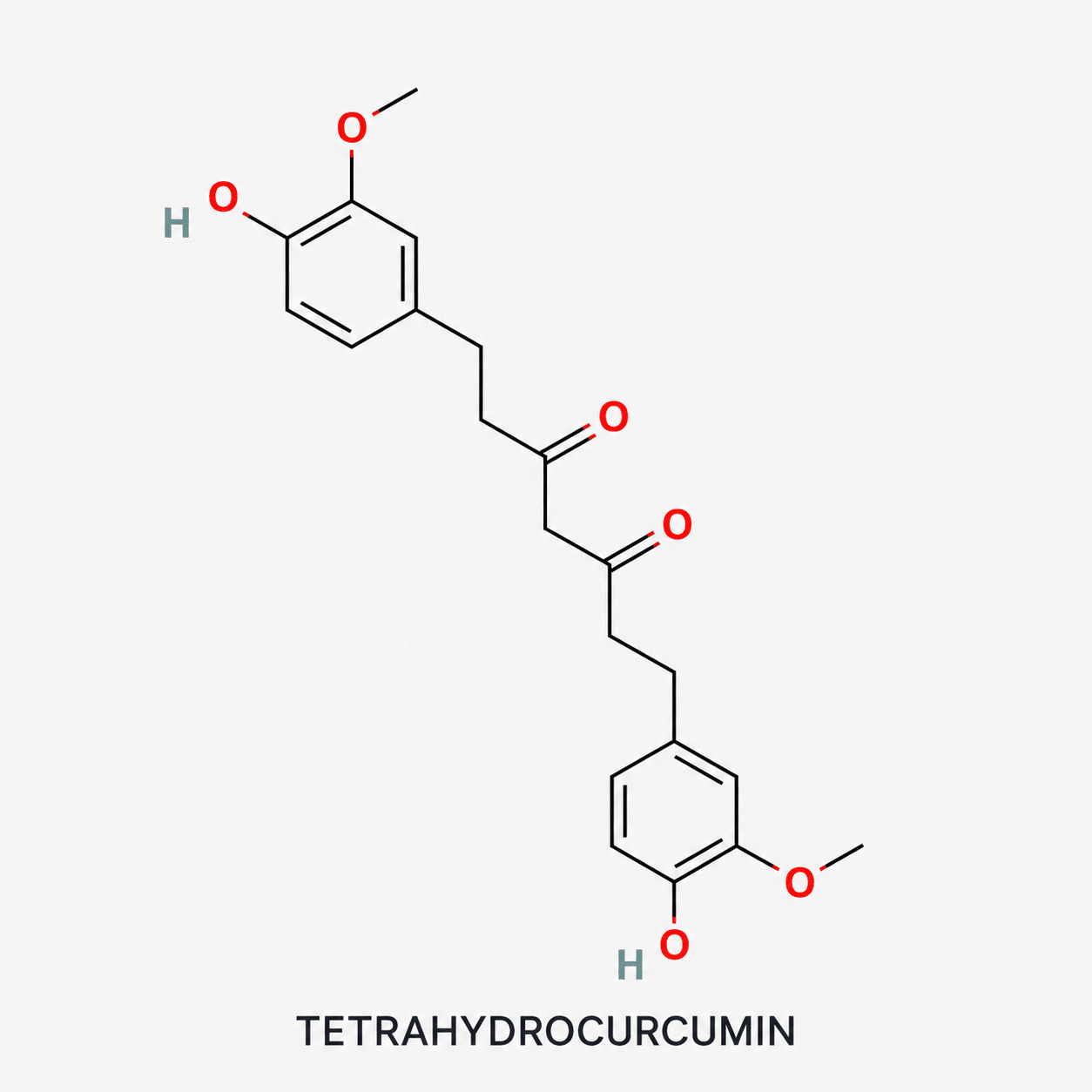
Tetrahydrocurcumin
Preisspanne: 19,00 € bis 29,00 €
Note: For research and educational purposes only. Not intended for human consumption.
Tetrahydrocurcumin offers a fresh angle on the science behind turmeric: the potential to help protect cells and keep them working well. It is one of the compounds formed when the body breaks down curcumin, turmeric’s best-known ingredient.
Its appeal centres on protecting delicate cell structures, helping cells deal with damage and looking after the systems that support memory and circulation. Laboratory and animal studies have explored these possibilities from several different angles.
i) The Pharmacology of Tetrahydrocurcumin — Explained Simply
1. Helping Cells Handle Wear and Tear
Cells need protection as well as fuel. Reactive molecules can damage their outer layer and other important parts when the cell’s defences cannot keep up. This is called oxidative stress. Antioxidants help limit that damage.
In laboratory tests, Tetrahydrocurcumin protected cell membranes — the thin outer layers that control what enters and leaves a cell. Other cell experiments found that it also helped activate the cell’s own protective systems. [1] [2]
Why it matters: its potential goes beyond limiting damage. It may also help cells call on their own defences.
2. Keeping the Brain’s Alarm System in Balance
The brain has its own protective cells that watch for trouble and respond to damage. Their response includes inflammation, which is useful when needed. But an alarm that stays switched on too strongly can put nearby cells under strain.
In laboratory experiments, Tetrahydrocurcumin reduced some of the chemical messages that drive this response in the brain’s protective cells. [2]
Why it matters: the possibility of a better balance between responding to a problem and letting surrounding cells work normally.
3. Looking After the Cell’s Energy Supply
Inside each cell are tiny structures that produce usable energy. They are called mitochondria. Nerve cells depend on them to keep sending and receiving messages.
In rats with an experimental brain injury, Tetrahydrocurcumin reduced signs of damage linked to these energy-producing structures. Researchers also saw signs of increased activity in the cell’s recycling system, which breaks down damaged parts. [3]
Why it matters: keeping cells in good working order involves both protecting useful parts and dealing with damaged ones.
4. Protecting the Foundations of Memory
Memory relies on more than nerve cells alone. The cells around them help provide the conditions they need to function.
Tetrahydrocurcumin improved learning and memory test results in mice with an Alzheimer-like condition. Related laboratory work also found protective effects in the brain’s support cells. Together, these findings give it an interesting place in the search for ways to protect the systems behind learning and memory. [4]
Why it matters: the potential to look after the foundations of memory. The results so far come from animal and cell studies.
5. Helping Blood Vessels Respond as They Should
Blood vessels need to relax and tighten to help control blood flow. Their inner lining helps coordinate this movement through chemical messages.
In rats with experimentally raised blood pressure, Tetrahydrocurcumin helped blood vessels respond more normally and reduced signs of oxidative damage. [5]
Why it matters: its protective potential also extends to the delicate lining that helps blood vessels do their job.
At a Glance
| Area | What has been observed | Why it is interesting |
|---|---|---|
| Cell protection | Less damage to cell membranes and greater activity in protective systems in laboratory tests. | Helping preserve the parts that keep cells working. |
| Brain inflammation | Fewer inflammation-related messages from brain immune cells in laboratory experiments. | Keeping the brain’s protective response in balance. |
| Energy & upkeep | Less damage linked to energy-producing structures and signs of more recycling activity in injured rats. | Protecting useful cell parts and dealing with damaged ones. |
| Learning & memory | Better test results in mice with an Alzheimer-like condition. | Exploring ways to protect the systems that memory relies on. |
| Blood vessels | More normal responses in rats with raised blood pressure. | Looking after the inner lining that helps regulate blood flow. |
ii) Potential / Hypothetical Profile
- Protection from Cellular Wear: potential to limit oxidative damage and help cells use their own defences.
- Care for the Brain’s Support System: interest in protecting the cells that help nerve cells work well.
- Better Cellular Upkeep: a possible role in protecting energy-producing structures and helping cells process damaged parts.
- Memory & Circulation: two promising areas of interest connected by the same idea — protecting the structures that normal function depends on.
| Συσκευασία | 5 g, 10 g |
|---|
TECHNICAL SPECIFICATIONS
- Product Name: Tetrahydrocurcumin
- CAS Number: 36062-04-1
- Molecular Formula: C21H24O6
- Molecular Weight: 372.42 g/mol
DISCLAIMER
As stated in the short description, this and other products of subsection of “Nootropics” in our e-shop are NOT intended for human consumption! Those products are available for collection purposes or for other lawful use for which the consumer has taken care to be explicitly informed on a personal level in every aspect that may be affecting them.
The information provided in the descriptions of products which can be found in “Nootropics” subsection – as available from ethosherbals.com, SMARTSHOP Main Category – is of an academic nature. This information is not intended to be used for human consumption of the products in question. It is not intended to diagnose, prevent or treat any medical condition. It is not intended to be a substitute for any medical treatment.
Πρέπει να είστε συνδεδεμένοι για να δημοσιεύσετε μια κριτική.


 Ethos Herbals Blends
 Κάνναβη
 SmartShop
 VapeShop
 Θεραπευτικά Βότανα
 Κακάο & Τσάι
 Αρωματοθεραπεία
 Ethos Lifestyle
Αξιολογήσεις
Δεν υπάρχει καμία αξιολόγηση ακόμη.